Rethinking B2B Data: Why Strategic Data Sourcing Is An Investment, Not An IT Expense

Listen to audio summary of this article
In enterprise finance, asset management, and supply chain logistics, capital allocation is governed by a fundamental law: the quality of inputs directly bounds the value of outputs.
No manufacturing CEO buys unvetted, off-the-shelf raw materials for precision engineering; no hedge fund manager trades on unverified, aggregated market noise.
Yet, in B2B go-to-market (GTM) strategy, an operational paradox persists. Enterprise revenue leaders routinely treat B2B data as a disposable software line item—buying flat-rate subscriptions to self-service data platforms and automated scrapers.
They treat prospect lists as low-cost commodities, expecting sales development representatives (SDRs) to brute-force outreach against static inventories.
When you treat market intelligence as a cheap commodity, you inherit its hidden liabilities: rapid decay rates, severe domain deliverability penalties, and wasted rep bandwidth. It is time to reframe data sourcing entirely: B2B data research is an asset-building investment that compounds in value across your entire revenue architecture.
The True Balance Sheet: Subscription Platforms vs. Strategic Capital
To understand why static software databases drag down enterprise margins, executives must evaluate the true cost of acquisition versus long-term asset value.
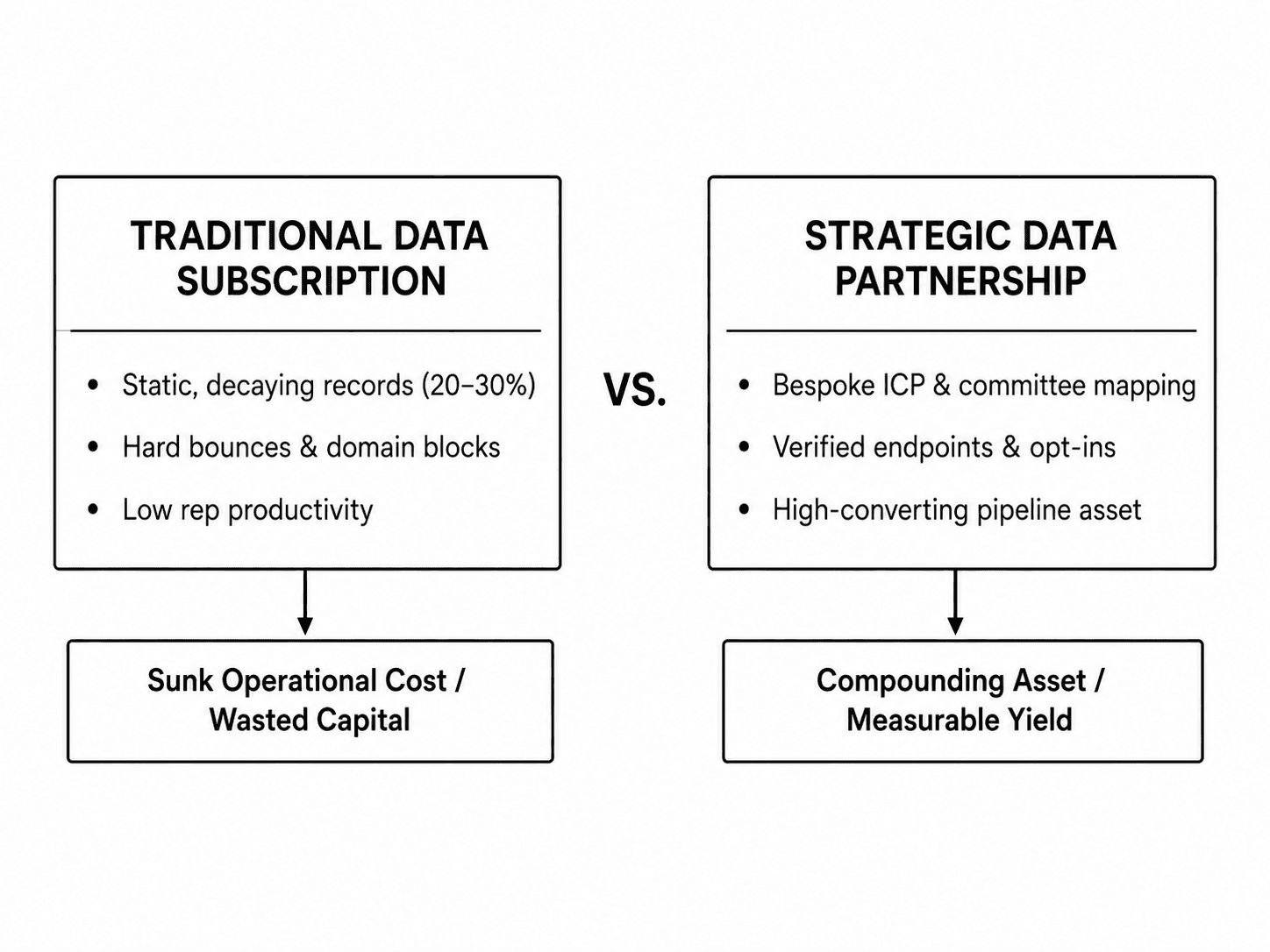
The Sunk Cost of Automated Subscription Databases
SaaS databases operate on volume-driven business models. They scrape public web layers, run basic syntax checks, and package pre-compiled contact snapshots into downloadable CSV files.
Accelerated Asset Depreciation: B2B contact records naturally decay at 20% to 30% annually due to job changes, corporate restructuring, and domain shifts. A static list bought in January is structurally impaired by Q3.
Systemic Risk to Brand Equity: Automated scrapers routinely hit hidden spam traps and unverified email endpoints. Hard bounce rates exceeding 2% degrade your domain sender reputation with major Email Service Providers (ESPs), dropping enterprise messages into spam folders and creating unseen deliverability bottlenecks.
Opportunity Cost of Sales Bandwidth: When account executives and SDRs spend 15–20 hours a week cross-referencing dead phone numbers, outdated titles, or generic info@ mailboxes, revenue acceleration stalls.
The Compounding Yield of Custom Research Partnerships
A strategic data partnership operates on a bespoke, human-in-the-loop research model. Rather than pulling from pre-compiled inventories, specialised researchers build custom datasets aligned with your exact Ideal Customer Profile (ICP), account buying committees, and regional nuances.
Investing in bespoke data sourcing turns market research into a high-yielding corporate asset:
Maximised Capital Efficiency: SDRs spend 100% of their operational hours engaging verified decision-makers, shortening sales cycles and increasing pipeline velocity.
Infinitely Scalable Domain Reputation: Verified corporate endpoints and clean data lineage ensure deliverability rates remain high (>95%), insulating your primary brand domains against blacklisting.
Proprietary Market Moats: Custom-built databases capture non-standard operational roles, niche industry titles, and emerging market registries that automated scrapers miss—giving your team exclusive access to accounts your competitors cannot find.
Institutional Comparison: Vendor Subscription vs. Strategic Sourcing Partner
Strategic Vector | Standard Data SaaS Subscription | Custom Data Sourcing Partner |
|---|---|---|
Financial Classification | Operating Expense (Sunk Software Cost) | Strategic Investment (Proprietary Asset Build) |
Data Sourcing Framework | Automated scraping & pre-compiled inventories | On-demand ground-up research & human verification |
Market Coverage | Broad, generic roles in mature markets | Hyper-niche verticals, complex buying committees, emerging regions |
Verification Layer | Algorithmic guessing & periodic pinging | Human-in-the-loop validation & double opt-in consent |
Integration & Alignment | Transactional self-service export | Embedded extension of revenue operations via direct CRM/API sync |
Unlocking Niche Verticals and Opaque Markets
Where automated SaaS platforms fail completely is in non-standard market environments.
If your organisation targets mainstream roles like "VP of Sales" at mid-sized SaaS companies, automated platforms provide surface-level coverage. But when expanding into complex verticals (e.g., Agritech, DeepTech, Renewable Infrastructure) or emerging global markets (LATAM, Southeast Asia, Middle East), standard scrapers collapse:
Fluid Role Architectures: Complex verticals feature non-standard job titles—such as Lead Regional Integration Engineer or Director of Scope 3 Compliance. Automated scrapers either miscategorise these key evaluators or miss them entirely. Human researchers decode non-traditional organisational charts to locate real purchasing power.
Opaque Regional Registries: In emerging markets, business intelligence is rarely centralised on professional networking sites. It lives inside multi-lingual trade filings, localised news releases, and regional corporate registries. Human research analysts navigate these unstructured sources to verify active decision-makers.
Audit-Ready Privacy Compliance: Navigating global privacy frameworks (GDPR, CCPA) requires traceable data provenance. Strategic research partners build verifiable consent markers and opt-in frameworks directly into your prospect lists, protecting your business against regulatory liability.
Treating Data Research as an Asset Class
When revenue leaders evaluate their go-to-market investments, the highest returns do not come from buying larger volumes of unverified software leads. They come from sharpening the precision of their outreach.
Investing in a dedicated B2B data research partnership gives your GTM organisation a continuous operational advantage. By replacing static, decaying databases with bespoke, human-verified market intelligence, you convert raw data from a risky operational expense into a high-performing revenue asset.