Critically Evaluating Waterfall Enrichment Models in Data Research

Listen to audio summary of this article
If you've looked at B2B data enrichment tools in the last year, you've run into the term "waterfall enrichment." It's become the default answer to a problem every revenue team knows well: no single database has everyone's current email, phone number, or job title.
So instead of accepting one provider's coverage, you query several, one after another, until something usable comes back.
It's a genuinely useful idea, and the match-rate improvements it delivers are real. It's also not the full answer to the accuracy problem it's trying to solve — and understanding why matters before you build a stack around it.
What Waterfall Enrichment Actually Is
The mechanics are simple. A record enters a workflow with a missing field — say, a verified email. The system checks Provider A. If nothing comes back, it tries Provider B, then C, and so on, until it finds a match or runs out of sources.
Two architectures dominate the market in 2026:
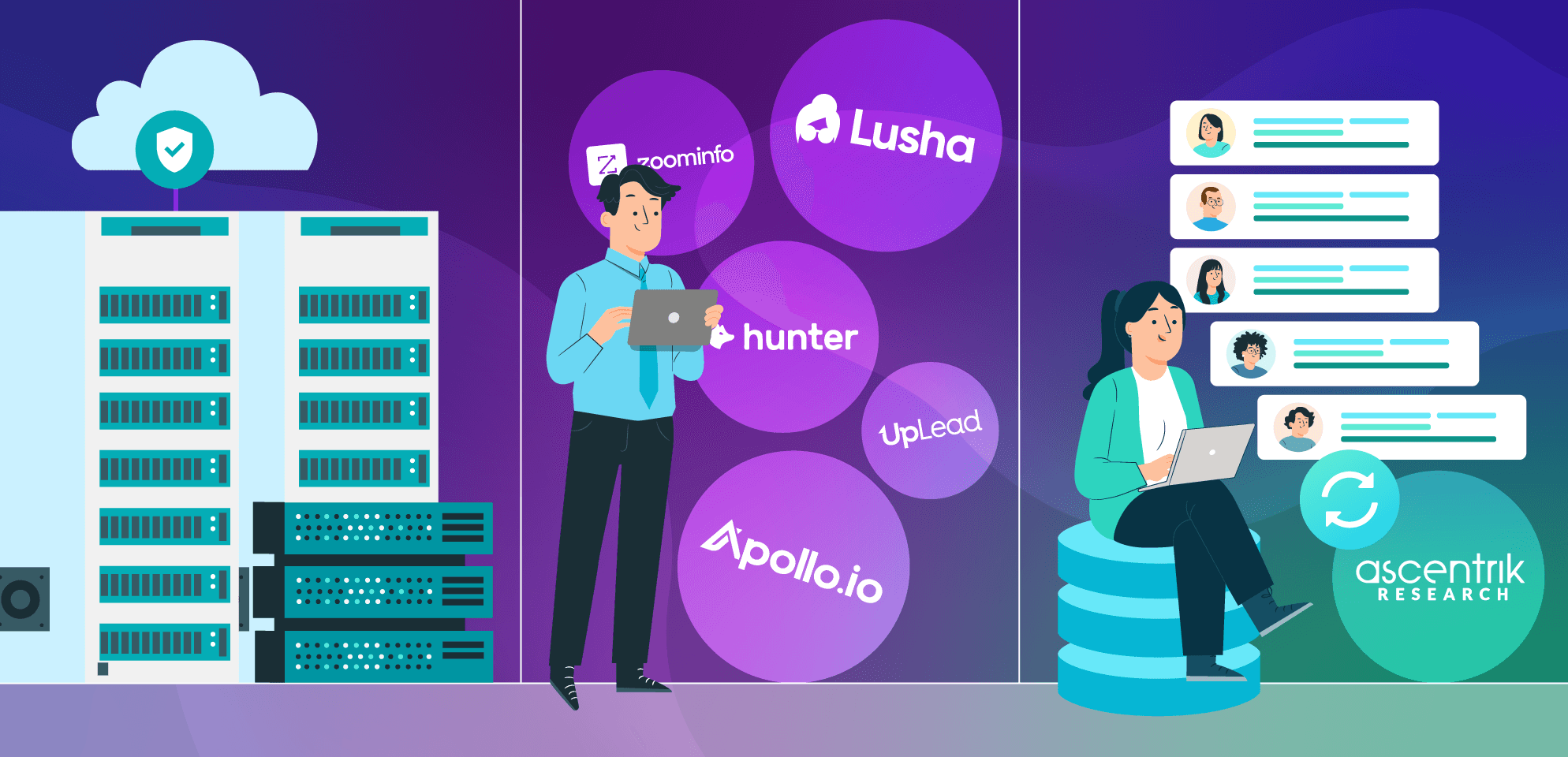
Sequential waterfalls, which the model Clay is best known for. They query providers one at a time in a defined order and stop at the first match. Clay orchestrates over 100 data sources this way, billing per successful lookup rather than a flat subscription — you only pay when a provider actually returns data.
Parallel waterfalls, which ZoomInfo introduced inside GTM Studio. They query 25+ third-party vendors simultaneously alongside ZoomInfo's own database, then use a scoring system to select the highest-confidence result across all of them rather than simply the first hit.
Both approaches solve the same underlying problem from different angles, and both represent a real improvement over relying on one static database.
Published benchmarks bear this out: single-source enrichment typically returns a valid match for only 50–70% of a list, while waterfalling across three or four providers lifts that to somewhere in the 80–95% range, depending on whose methodology you trust.
What the Match-Rate Number Doesn't Tell You
The percentage is the headline stat in nearly every comparison of these tools, and it's the wrong number to optimise for on its own. A few things get lost underneath it.
Diminishing returns set in fast. Independent benchmarking on waterfall performance shows the improvement curve bends quickly — the jump from one provider to two is large, but each additional source after that contributes progressively less.
One widely cited 2026 analysis found right-person match rates moving from roughly 51% with a single provider to about 65% after stacking four — a real gain, but far short of the "near 100%" impression the word "waterfall" tends to create.
A match isn't the same as a current fact. Every provider in a waterfall stack — whether it's Clay's 100+ integrated sources or the 25+ vendors ZoomInfo queries in parallel — is still pulling from a stored database somewhere.
Stacking five stale databases produces a higher chance that one of them happens to be right at this moment, but it doesn't make any individual source fresher. Match rate measures whether a field got filled in; it says nothing about whether the person still holds that job, or whether the company still exists under that name.
Coverage gaps cluster exactly where it hurts most. Waterfall tools genuinely close a large share of the gap on mainstream contacts — common titles, common industries, major markets. They close a much smaller share of it on the records that were hard to find in the first place: niche job functions, specialised verticals, emerging markets, or matrixed organisational structures where "who actually owns this decision" isn't a field any database captures well.
That's not a criticism of the tools — it's a structural limit of querying databases that were all built the same way, by scraping and aggregating the same public web. Someone still has to manage the stack.
Sequential tools like Clay require configuring priority order, fallback logic, and quality thresholds across dozens of vendors — real work that typically falls to a RevOps function. Parallel tools like GTM Studio remove some of that configuration burden, but at the cost of being tied to one platform's vendor mix and pricing.
Either way, "waterfall enrichment" isn't a switch you flip; it's infrastructure someone has to own.
How to Evaluate a Waterfall Setup Beyond the Headline Number
Given all of the above, match rate alone is a thin basis for judging whether a waterfall setup is actually working for you. A few sharper questions tend to reveal more:
What's the marginal gain of each additional source? If your third or fourth provider is adding only a percentage point or two, you may be paying for configuration complexity without a proportional return.
Where specifically are the remaining gaps concentrated? A stack that performs well overall but consistently misses one vertical, region, or job function is telling you something a blended match-rate figure hides.
How is "confidence" actually being scored? In a parallel waterfall, the logic used to pick a winning result across vendors matters as much as how many vendors are queried — a scoring system that favours recency or corroboration across sources is a meaningfully different guarantee than one that simply favours whichever provider responded first.
Who owns the stack when something breaks? A vendor drops out, a data source degrades, a fallback rule stops making sense as your ICP shifts — someone needs to be accountable for noticing and adjusting, not just for the initial setup.
Does the match rate hold up on your actual target list, not just the vendor's benchmark? Published benchmarks are typically run against broad, mainstream datasets. The number that matters is what the same stack returns against your specific accounts.
Waterfall enrichment is a genuine advance over relying on a single static database, and for high-volume, mainstream prospecting it remains one of the more efficient ways to close coverage gaps at scale.
The useful discipline is treating the match-rate percentage as a starting point for questions, not as the final verdict — because the number that gets published in a comparison chart and the number that reflects what actually lands in your CRM are not always the same thing.
FAQ
Is a higher match rate always better when comparing waterfall enrichment tools?
Not on its own. A higher blended match rate can still hide weak coverage in the specific segment you care about, or reflect diminishing returns from stacking additional low-value sources. It's worth checking where the gains are actually coming from before treating the headline number as decisive.
Does querying more providers in a waterfall always improve data quality?
It improves the odds of finding a match, but each additional source is still drawing from a stored, aggregated database rather than confirming a fact in real time. More sources raise the chance one of them is currently correct — they don't make any individual source more current on their own.
How often should a waterfall enrichment stack be reviewed?
Regularly, and not just when match rates visibly drop. Vendor coverage shifts, pricing changes, and your own target market evolves, so a stack configured well a year ago may no longer reflect the best available order or mix of sources today.