What is Match Rate in Ad Campaigns—and Why Do Low Match Rates Dilute Your Ad Budget?

Listen to audio summary of this article
In B2B digital marketing, paid social and display advertising are no longer about broad demographic targeting. To capture enterprise accounts, marketing teams rely on custom audience uploads across platforms like LinkedIn, Google, Meta, and programmatic DSPs.
You export a list of 10,000 ideal decision-makers from your database, upload the file, and wait for the platform to target them. But when the platform finishes processing, the result is disheartening: Match Rate: 28%.
Suddenly, 7,200 of your ideal prospects have vanished from your campaign before a single impression is served.
Understanding Match Rate—and why automated, off-the-shelf lists routinely collapse during audience matching—is the difference between an ad budget that drives measurable pipeline and one that burns through capital on missed connections.
What is a B2B Email Data Match Rate?
A B2B email data match rate is the percentage of your customer or lead records (such as names, company domains, or physical addresses) that successfully pair with verified email addresses and identity profiles in an ad platform’s user graph or a third-party vendor's database.
When you upload a target list, the ad network's algorithm runs an identity resolution process. It hashes your data inputs and cross-references them against the personal and professional credentials users used to register their accounts. If the platform cannot find an exact match between your record and an active user profile, that prospect is excluded from your campaign.
Why Low Match Rates Dilute Your Ad Budget
When marketing teams buy static databases or rely on automated web scraping software to build their ad targeting lists, match rates suffer drastically. Standard subscription databases routinely deliver match rates between 20% and 40%.
This low performance dilutes your advertising budget across three major vectors:
1. Severe Data Decay and B2B Identity Fragmentation
B2B contact data decays at a staggering rate of 20% to 30% annually as professionals switch roles, companies rebrand, or domain structures change. Automated scrapers populate databases with static snapshots. When you upload an outdated corporate email address for a decision-maker who left their job six months ago, the ad network fails to match the record.
2. The Personal vs. Professional Email Disconnect
Ad networks—especially Meta, Google, and YouTube—are heavily anchored to personal email addresses (e.g., Gmail, Yahoo) that users created years ago. If your uploaded list contains only a business email address (e.g., john.doe@enterprise.com), but the decision-maker registered their personal ad profile under johndoe88@gmail.com, an automated match fails. Without multi-point identity mapping, your business email list drops off the platform.
3. "Trash Inputs" and Generic Catch-All Addresses
Automated scrapers frequently pull generic, role-based mailboxes like info@, sales@, or support@ when they cannot isolate direct human endpoints. Ad networks rarely map role-based emails to individual user profiles, meaning these records are instantly discarded during processing.
4. Artificial CPM Inflation and Sub-Optimal Bidding Algorithms
Modern ad platforms use machine learning to optimise ad delivery based on audience scale and engagement signals. When your matched audience shrinks from 10,000 to 2,500 due to dirty data, the algorithm is forced to bid aggressively within a tiny pool. This artificial bottleneck inflates your Cost Per Mille (CPM) and Cost Per Click (CPC), forcing you to pay significantly more to reach a fraction of your actual target market.
Actionable Strategies to Boost Your B2B Match Rates
To prevent budget leakage, revenue teams must optimise their data upload strategies and enforce continuous data hygiene.
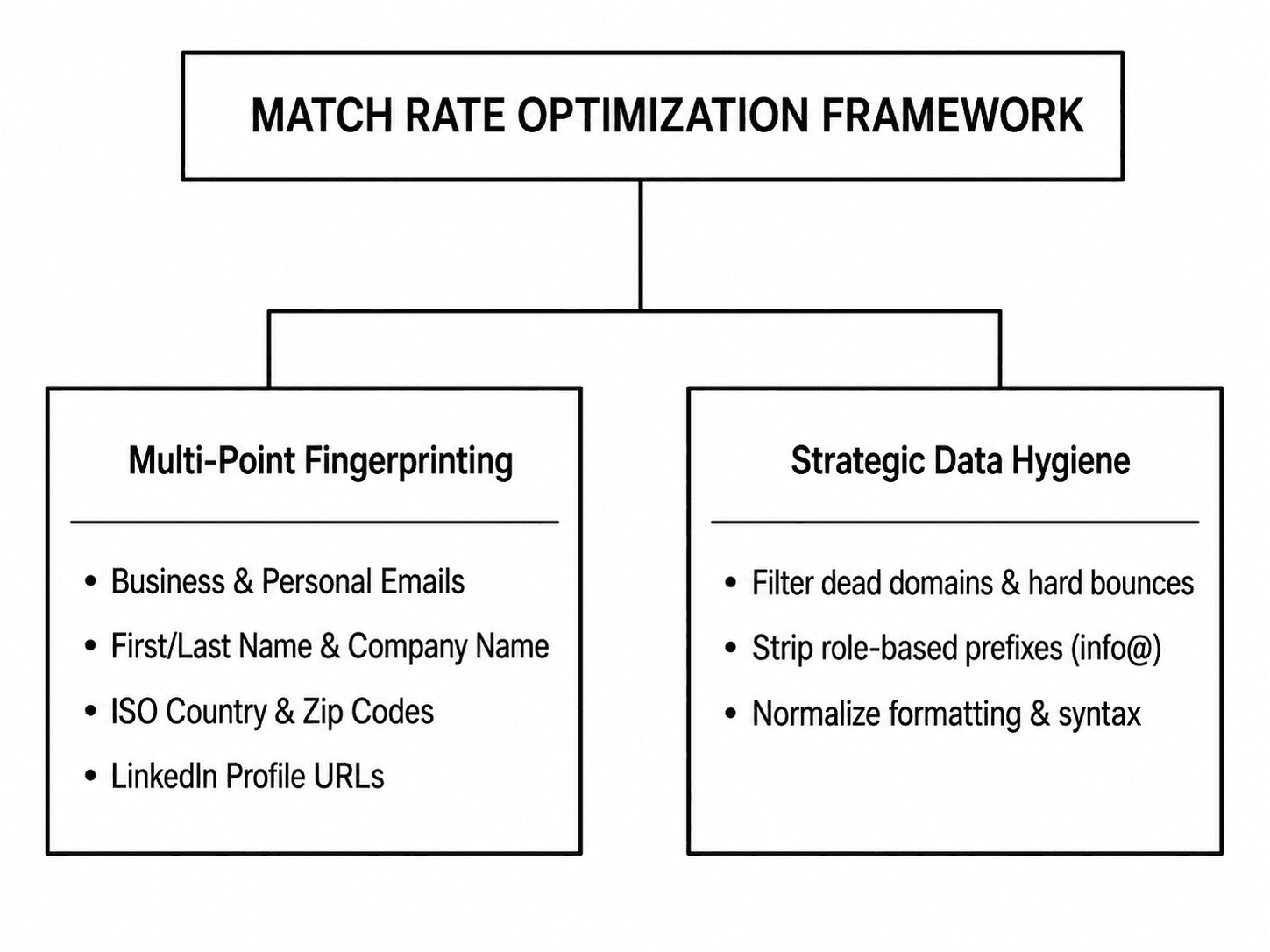
1. Optimize Your Data Upload Strategy
Provide Multiple Identifiers: Never upload a single column of business emails. Include First Name, Last Name, Company Name, Country, Zip Code, and LinkedIn Profile URL. Multi-point fingerprinting gives ad platform identity graphs multiple hooks to anchor a match.
Normalise Your Formatting: Standardise your CSV file prior to upload. Convert country fields into standard ISO codes, remove non-alphanumeric characters, clean casing, and verify zip code formatting.
Capture Dual-Email Profiles: Formulate web forms and enrichment pipelines to collect both primary business emails and secondary personal emails. Uploading both fields drastically increases match rates on platforms like Google and Meta.
2. Implement Continuous Data Hygiene
Filter Out Dead Domains: Run legacy lists through email verification software before attempting platform matching. Dead endpoints signal decaying records that will never match.
Strip Generic Prefixes: Purge all catch-all addresses (info@, admin@, sales@). Focus 100% of your upload real estate on direct, human-verified endpoints.
How Custom Research Partners Solve the Match Rate Bottleneck
While basic self-service cleaning tools help, automated software cannot resolve complex B2B identities or uncover missing personal endpoints. This is where a dedicated B2B data partner like Ascentrik Research transforms ad campaign economics.
Instead of relying on static database exports, Ascentrik provides custom B2B data research engineered to maximise audience match rates across ad networks and email campaigns.
Human-in-the-Loop Multi-Point Fingerprinting
Ascentrik's full-time research analysts don't just pull single data fields. When building or enriching a custom target list, researchers manually cross-reference decision-maker profiles across corporate directories, social graphs, and regional registries.
We map verified business emails alongside personal email anchors, verified LinkedIn URLs, exact job titles, and direct dials—giving ad platform algorithms maximum inputs to achieve match rates exceeding 70% to 90%.
On-Demand Cleansing and Live Verification
Because Ascentrik builds datasets on-demand according to your specific Ideal Customer Profile (ICP), your target lists are completely free from historical data decay. Our human-in-the-loop verification purges dead domains, merges duplicate records, and strips role-based emails before you spend a single ad dollar.
Maximising Campaign ROI Across All Channels
High match rates don't just save ad spend—they align your paid media directly with your outbound sales effort. By partnering with a custom data researcher, your sales team's direct email sequences match the exact target accounts seeing your paid social ads, creating a unified, multi-touch account-based marketing (ABM) engine.
Stop Paying for Unmatched Audience Lists
In digital advertising, audience scale is meaningless if the platform cannot find your target buyers. Stop letting low match rates eat away at your campaign budgets.
By shifting from static software databases to a dedicated research partner, you equip your ad campaigns with human-verified, multi-identifier datasets designed to match. Contact Ascentrik Research today to audit your prospect lists, boost your ad platform match rates, and maximise your return on ad spend.