Getting ICP Right is Key to Effective Prospecting: Guide to Uncovering Ideal Customers

Listen to audio summary of this article
The Real-World ICP Trap: Why Most Target Lists Fail Before They Start
As a specialised research agency, we frequently ask new clients to provide a sample prospect list or ICP before we begin sourcing b2b data. Inevitably, LinkedIn is their go-to source for this initial benchmark.
Recently, however, we’ve observed a recurring—and costly—pattern: junior marketers and young sales recruits are building these initial seed lists in a fundamentally flawed, surface-level way.
They log into LinkedIn Sales Navigator, apply a few broad filters—like "VP of Marketing," "Renewable Energy," and "50-200 Employees"—and build a list out of the results. To a junior recruit, the list looks complete. But when our research team conducts a deep-dive audit of these client-provided samples, the structural errors immediately surface:
Title Ambiguity: "Head of Operations" in a 20-person startup carries a completely different scope of budget authority than the same title in a $500M enterprise.
Irrelevant Accounts: Companies tagged under broad LinkedIn industry categories like "Hospital & Health Care" often include local dental clinics or medical staffing agencies alongside the actual target—multi-site hospital networks.
Missing Buying Committees: The seed list captures a single, obvious title while completely ignoring the technical evaluators, compliance officers, and line-of-business leads who actually hold veto power.
When an initial ICP is built on lazy filtering, every downstream dollar spent on b2b data sourcing, cold email sequences, ad targeting, and SDR phone calls is wasted.
When our team brings these flaws to light, we guide clients on how to use LinkedIn and secondary sources far more effectively, for building prospect lists. But more importantly, we help them realise a fundamental truth: LinkedIn filters only show you who people claim to be—they don't show you what those companies are actually doing.
To build a high-converting target list in complex verticals, you have to look beyond static social profiles and start mapping operational signals.
Isolating High-Intent Accounts in Complex Verticals
Standard Account-Based Marketing (ABM) strategies frequently stall at the top of the funnel. The reason is simple: most Ideal Customer Profile (ICP) frameworks rely on superficial parameters—such as broad industry verticals, employee headcount, or geographic zip codes.
In complex, high-friction sectors like HealthTech, DeepTech, Green Energy, and Industrial Logistics, basic firmographics fail to identify true buyer intent. Operating in these environments requires shifting from static demographic filtering to operational signal mapping.
This guide outlines a repeatable framework for building hyper-segmented, signal-driven target account lists, mapping invisible buying committees, and accelerating multi-channel email and cold-calling campaigns.
The Failure of "Firmographic-Only" Targeting
Relying solely on revenue thresholds or basic SIC codes creates two major operational bottlenecks for outbound revenue teams:
Wasted Outbound Capacity: Sales Development Representatives (SDRs) spend 60% of their outreach bandwidth pitching accounts that meet basic firmographic criteria but lack immediate operational need or budget allocation.
Generic Value Propositions: Broad targeting forces marketing teams into generic messaging during b2b campaigns. In complex verticals, a single generic phrase in a cold email or call script instantly triggers buyer skepticism.
To build a high-converting Ideal Customer Profile, revenue operations teams must define accounts using Operational Variables—the internal systems, regulatory pressures, technical debt, and hiring behaviors that indicate an immediate business trigger.
Industry Blueprint 1: Green Energy & Infrastructure
Target Sub-Sector: Commercial Solar & Grid-Scale Battery Energy Storage Systems (BESS)
The Static Mistake: Targeting "Renewable Energy Companies in Europe/US with $50M+ Revenue."
The Operational ICP: High-intent accounts identified through regional grid capacity limits, municipal permitting activity, and specialised engineering hiring.
Operational Signal Mapping
Municipal & Interconnection Requests: Monitor public utility filings, regional land use permits, and grid interconnection queues. A company filing for a sub-station connection permit is entering an active capital expenditure cycle.
Technographic & Asset Footprint: Track accounts deploying specific supervisory control and data acquisition (SCADA) software or investing in high-voltage transformer hardware.
Hiring Spikes: Filter for companies actively hiring Interconnection Engineers, Environmental Permitting Managers, or Grid Compliance Officers within specific regional markets.
Buying Committee Map
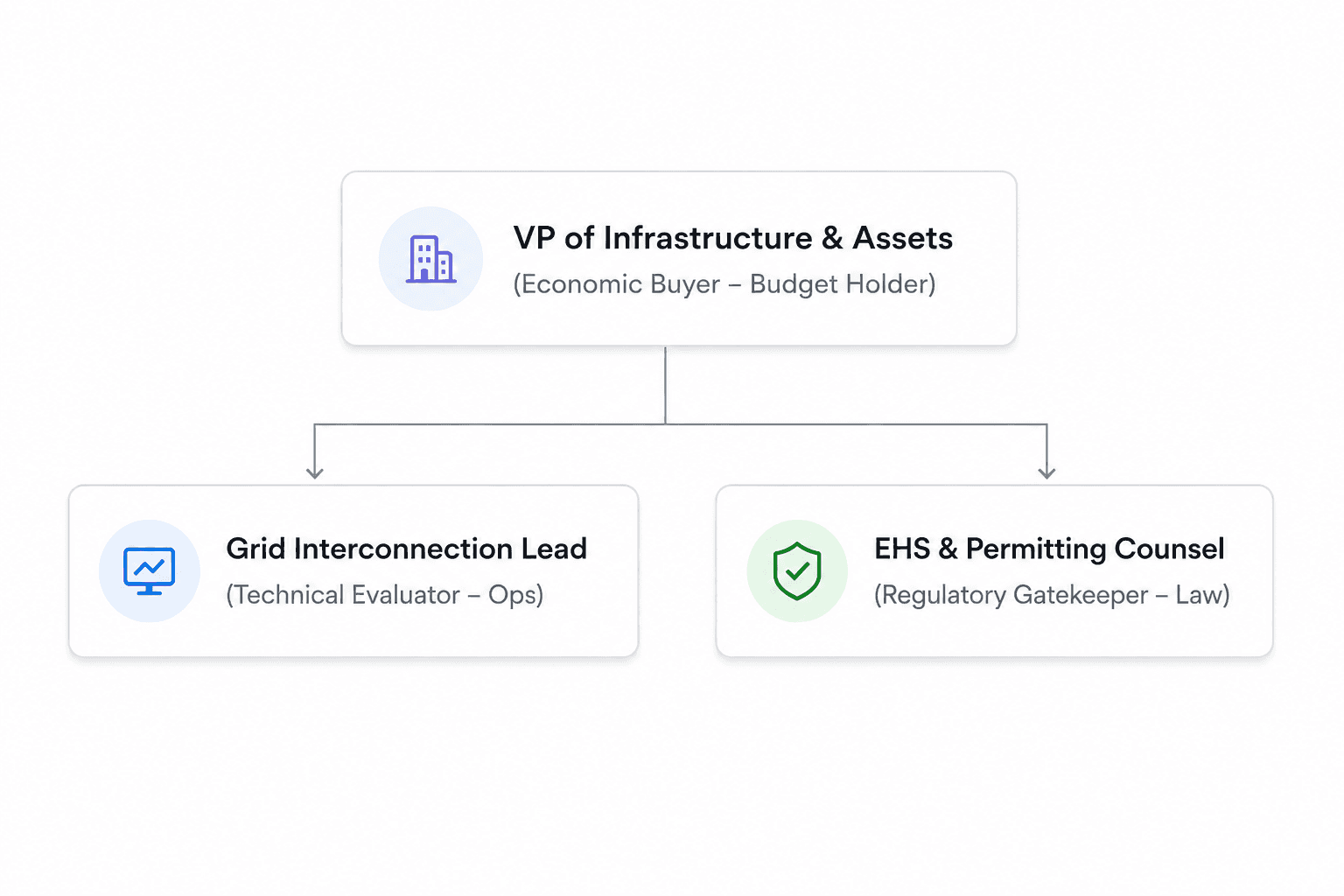
Cold Email Angle: Reference the specific regional grid queue or regulatory milestone: "Noticed your team recently filed for interconnection approval in the PJM market..."
Cold Call Opening: Address the technical evaluator's operational hurdle directly: "Most Interconnection Leads we speak with are running into 8-month delays on transformer procurement..."
Industry Blueprint 2: Industrial Logistics & Cold Chain
Target Sub-Sector: Pharmaceutical & High-Value Cold Chain Logistics
The Static Mistake: Targeting "Transportation & Logistics Companies with 500+ Employees."
The Operational ICP: Logistics providers upgrading temperature-monitoring infrastructure to meet revised FDA/EMA regulatory guidelines.
Operational Signal Mapping
Facility Expansion & Warehouse Permits: Track commercial real estate filings for cold-storage facility builds or cold-room retrofits.
Compliance & Inspection Audits: Cross-reference regulatory database updates (e.g., FDA inspection reports or GDP compliance certifications). An account facing recent audit observations is actively seeking risk mitigation solutions.
IOT & Sensor Stack Deployment: Identify companies using legacy temperature-data loggers versus real-time cellular IoT telematics across their fleet.
Buying Committee Map
Economic Buyer: VP of Global Supply Chain / Chief Operations Officer (Focus: Risk mitigation, SLA guarantees).
Technical Evaluator: Director of Quality Assurance & GDP Compliance (Focus: Regulatory audit trails, sensor precision).
User Champion: Fleet Operations Manager / Warehouse Operations Lead (Focus: Dashboard ease of use, alert fatigue).
Multi-Channel Trigger: When a new facility permit is issued, initiate a synchronized campaign: a personalized email to the QA Director detailing compliance automation, followed 24 hours later by an SDR phone call to Fleet Operations referencing the expansion.
Industry Blueprint 3: HealthTech & Hospital Systems
Target Sub-Sector: Enterprise Patient Engagement & EHR Integration Software
The Static Mistake: Targeting "Hospitals and Healthcare Networks with 1,000+ Beds."
The Operational ICP: Health systems running legacy, non-interoperable Electronic Health Record (EHR) modules undergoing digital modernization.
Operational Signal Mapping
EHR Architecture Disparities: Target health networks that have acquired regional clinics using disparate systems (e.g., Epic at the main hospital, Cerner or AthenaHealth at regional sites).
Federal & Regional Quality Score Metrics: Track publicly reported hospital readmission penalties or patient satisfaction scores. Low scores in specific metrics indicate active budget allocation for remediation.
C-Suite & IT Restructuring: Monitor executive transitions, specifically the hiring of a new Chief Information Officer (CIO) or Chief Digital Officer (CDO) within the last 90 days. New tech leadership almost always evaluates existing vendor contracts within their first two quarters.
Framework: Building Your Hyper-Specific ICP Matrix
To operationalise this model across your SDR and marketing teams, structure your target database using this four-layer specification matrix:
Layer | Variable Type | Example Data Point | Actionable Outbound Impact |
|---|---|---|---|
Layer 1 | Firmographic Baseline | $100M Revenue; 500 Employees; US/UK Market | Establishes total addressable pool. |
Layer 2 | Technographic Context | Uses Salesforce + Legacy ERP + Cloud Migration AWS | Filters for system compatibility. |
Layer 3 | Operational Trigger | Active hiring for 3+ DevOps Engineers; 2 Facility Expansion Permits | Identifies active investment phase (High Intent). |
Layer 4 | Buying Committee | VP Infra (Economic) + Compliance Lead (Evaluator) | Enables hyper-personalised, multi-threaded outreach. |
Execution Checklist for Revenue Leaders
Audit Your Current ICP: Strip out broad definitions. Replace generic revenue filters with 3–4 specific operational triggers.
Map the Full Committee: Never launch an email sequence or cold-calling program aimed at a single contact. Ensure every account has at least 3 mapped buying roles (Economic, Technical, User).
Align Outbound Copy to Operational Triggers: Ensure your SDR cold call scripts and automated email sequences directly reference the operational variable (e.g., tech stack migration, permit filing, executive hire) within the first two sentences.
Deploy Human-in-the-Loop B2B Data Verification: Because operational signals decay rapidly, ensure every account and direct-dial endpoint is custom-verified before launching campaigns to preserve domain health and maximise connection rates.
Table of Content