Developments in Data Research and Data Partnerships in 2026: Pay-for-Research vs Online Subscriptions vs In-House Teams
Published on: 22 Jan 2026
Last updated: 22 Jan 2026
Listen to audio summary of this article
Data managers, marketing, and sales teams face growing pressure to deliver precise, compliant, and actionable B2B data at scale.
Traditional approaches like bulk database subscriptions and internal hiring are increasingly strained. This is due to data decay, regulatory complexity, and the need for niche targeting.
A newer model, "pay-for-research," has emerged as a flexible alternative, offering bespoke accuracy without fixed costs or long-term commitments.
The evolving data landscape in 2026
B2B data needs have shifted dramatically. Generic contact lists no longer suffice for complex sales motions, ABM campaigns, or niche verticals. Teams now require:
Hyper-relevant data matching specific ICPs, buying committees, and intent signals.
Near‑real‑time freshness to catch job moves, company changes, and trigger events.
Ironclad compliance with global privacy laws, including explicit consent documentation.
At the same time, economic pressures demand cost efficiency. Fixed subscriptions and headcount carry risks when campaigns fluctuate. Pay-for-research fills this gap by charging only for successful, verified outputs, with guarantees for accuracy and replacement.
Model 1: Online database subscriptions
Subscription platforms promise instant access to millions of contacts, firmographics, and technographics. They work well for certain use cases but come with trade-offs.
Strengths
Speed and scale: Downloadable lists or API access for immediate use in CRM, MAP, or outreach tools.
Predictable pricing: Monthly or annual fees spread costs over time.
Broad coverage: Strong for mainstream industries, roles, and geographies.
Limitations
Staleness risk: Prebuilt databases inevitably decay; even with automated refresh, accuracy hovers around 80-90% over time.
Generic fit: Data is optimised for mass markets, not niche verticals, emerging roles, or hyper‑specific ICPs.
Compliance opacity: Consent practices vary, and audit trails may not meet strict regional requirements.
No exclusivity: Your competitors access the same data, diluting competitive advantage.
When to choose subscriptions
High‑volume, low‑precision campaigns where some staleness is acceptable (e.g., broad awareness or event promotion).
Teams needing quick enrichment for existing leads or firmographics.
Model 2: In-house research teams
Building internal capacity offers full control and deep alignment but requires significant investment.
Strengths
Perfect alignment: Researchers understand your exact ICP, strategy, and nuances.
Data ownership: No reliance on external providers; full control over processes and IP.
Strategic insights: Ongoing work builds institutional knowledge about markets and prospects.
Limitations
High fixed costs: Salaries, training, tools, and benefits for skilled researchers are expensive.
Capacity constraints: Teams scale slowly and struggle with volume spikes or deadlines.
Skill gaps: B2B research demands expertise in sourcing, verification, compliance, and tools—hard to maintain internally.
Burnout and turnover: Repetitive tasks lead to attrition, disrupting continuity.
When to choose in-house
Large, stable organisations with consistent high‑volume needs and long‑term data as a core competency.
When regulatory or competitive sensitivity demands absolute control.
Model 3: Pay-for-research partnerships
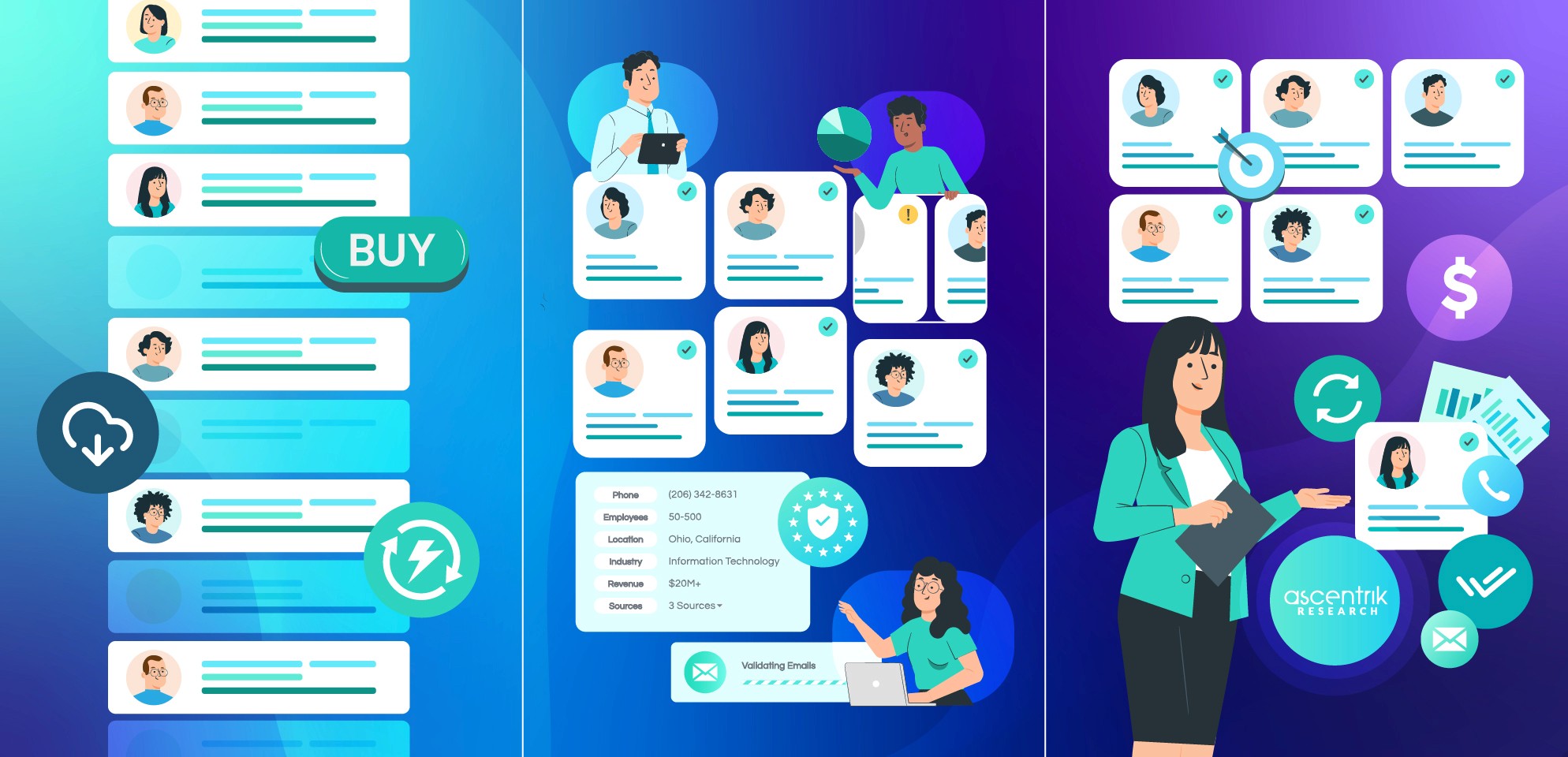
Pay-for-research flips the model: you pay only for verified, successful records delivered to specifications, not for access, seats, or unused capacity. Providers like Ascentrik Research have refined this over a decade, blending human expertise with advanced tools.
How it works
Bespoke briefs: Define your ICP (industry, size, role, geography, triggers), volume, accuracy threshold, and timeline.
Dedicated execution: A full-time team of researchers sources, verifies, and enriches data using multiple channels (directories, events, publications, networks).
Pay per success: Bill only for records meeting your acceptance criteria (e.g., valid email, phone, job title, consent). Includes replacement guarantees.
No storage: Data is built fresh for your project, never stored or resold.
Strengths
Superior accuracy: Human oversight catches nuances automation misses; typical targets exceed 95-99% validation.
Niche mastery: Handles hard‑to‑find segments, emerging markets, or custom fields unavailable in subscriptions.
Flexibility: Scale up for launches or down for maintenance; no long‑term lock‑in.
Compliance built‑in: Consent workflows, audit trails, and regional expertise reduce risk.
Cost efficiency: Pay only for usable data, avoiding waste on stale or irrelevant records.
Limitations
Slower for mass volume: Best for precision over quantity; not ideal for millions of broad contacts.
Dependency on partner: Success hinges on provider quality and communication.
When to choose pay-for-research
Complex ABM, enterprise sales, or niche campaigns where precision drives ROI.
Fluctuating needs or budget constraints that make fixed costs risky.
When exclusivity, freshness, and compliance outweigh speed alone.
Head-to-head comparison
Aspect | Subscriptions | In-House | Pay-for-Research |
|---|---|---|---|
Cost Structure | Fixed monthly/annual | Fixed salaries + overhead | Pay-per-verified record |
Accuracy | 80-90% typical | High (if skilled) | 95-99%+ with guarantees |
Speed | Instant access | Medium (team ramp-up) | Project-based (days/weeks) |
Niche Coverage | Limited | Medium | Excellent |
Flexibility | Low (commitment required) | Low (headcount fixed) | High (scale on demand) |
Compliance Risk | Medium (varies by provider) | Low (internal control) | Low (built-in processes) |
Exclusivity | None | Full | Full |
Technology and process innovations driving pay-for-research
In 2026, pay-for-research providers leverage cutting‑edge tools while keeping humans central:
AI‑assisted sourcing: Machine learning scans public sources, company websites, and signals at scale to surface candidates for human review.
Real‑time validation: Advanced email/phone checkers with multi‑factor confirmation (MX records, SMTP ping, pattern analysis).
Intent and trigger detection: Natural language processing identifies hiring, funding, or reorg signals from news and social.
Compliance automation: Tools flag risky sources and generate consent documentation.
The result: turnaround times that rival subscription models (often 24-72 hours for smaller projects), with far higher quality.
Case studies: Real-world outcomes
Enterprise ABM campaign
A software firm needed 5,000 contacts in healthcare IT, VP-level, with specific EHR tech stacks. Subscriptions yielded only 40% match rate with high bounces. Pay-for-research delivered 98% accuracy in 10 days, boosting meeting rates by 3x.
Event follow‑up lists
A conference organiser wanted attendee‑like profiles for post‑event nurture. In-house lacked bandwidth; subscriptions were too generic. Pay-for-research built 2,000 verified prospects in 48 hours, driving 25% open rates.
Niche vertical expansion
A fintech targeting commodities trading firms struggled with sparse subscription data. Pay-for-research sourced 1,200 decision‑makers across obscure sub‑verticals, including mobile numbers and trigger events, enabling a successful market entry.
Compliance and privacy in 2026
Regulations continue tightening: GDPR evolutions, CCPA expansions, and new rules in Asia-Pacific demand more than just “opt‑in.” Pay-for-research excels by:
Documenting sourcing paths and consent mechanisms per record.
Offering double opt‑in where required.
Adapting to region‑specific rules (e.g., PECR in UK, LGPD in Brazil).
Subscriptions often lag here, while in-house requires ongoing legal expertise.
Future trends shaping data partnerships
Looking ahead to late 2026 and beyond:
Intent‑driven research: Real‑time integration of buying signals with contact data.
AI‑human hybrids: More automation in sourcing, with humans handling verification and nuance.
Zero‑storage models: Blockchain or ephemeral processing for ultimate privacy.
Embedded partnerships: Data teams as extensions of your RevOps, co‑owning ICP evolution.
Choosing the right model for your team
No single approach fits every organisation, but hybrid strategies are gaining traction:
Subscriptions for baseline enrichment and broad prospecting.
Pay-for-research for high‑stakes campaigns and niche needs.
In-house for core strategy and oversight.
Evaluate based on your volume, precision needs, budget flexibility, and risk tolerance. Test small projects with pay-for-research providers to benchmark against your current setup.
Why Pay-for-Research is gaining momentum
Over the past decade, specialists have invested in processes, talent, and technology to deliver subscription‑like speed with in-house quality. Providers now offer SLAs for accuracy, turnaround, and replacement—making it a low‑risk way to access world‑class research capacity.
For data managers balancing growth targets with tight budgets, pay-for-research represents the best of both worlds: the precision of custom work without the overhead, and the speed of tech without the staleness.
Table of Content